Thermoplastic road marking paint plays a vital role in ensuring long-lasting and visible road lines. Learn more about the product here: BOLE Thermoplastic Road Marking Paint.
This guide outlines critical testing methods used to assess performance, safety, and durability. For more on strengths and weaknesses of thermoplastic paint, or how long it lasts, check these resources.
Film thickness is a core quality parameter. It is typically measured using a dry-film thickness gauge specifically designed for pavement applications. These gauges provide high-accuracy readings (to 0.01 mm) by contacting three points on the surface and averaging the results.
Standard thermoplastic markings should have a dry film thickness of 1.5–2.0 mm, within the national allowable range of 0.7–2.5 mm. To ensure consistency, measurements are taken at the beginning, middle, and end of each line section and averaged. More information on standards can be found here.
Uniform thickness improves line durability and retroreflectivity. Lines that are too thick waste material, while those too thin wear out quickly.
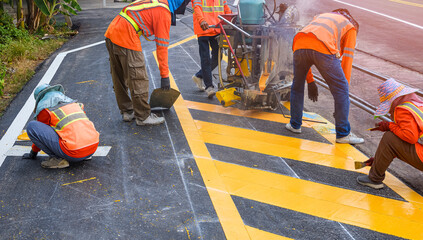
Adhesion is key to line longevity. If the paint does not adhere properly, it may peel off prematurely under traffic load or due to temperature changes.
There are three primary methods used:
These tests are simple but effective ways to identify bonding issues early in the inspection process.
Abrasion resistance indicates how well the paint withstands traffic. The Taber Abrasion Test (ASTM D4060) is commonly used in labs, applying rotating wheels (CS-10 or CS-17) under defined pressure to measure wear loss.
Results are reported as a wear index—mass lost per 1000 cycles. The lower the value, the better the resistance. In field tests, inspectors observe whether lines lose width or thickness in high-traffic areas.
High abrasion resistance is essential for longer service life. For enhanced durability, aggregates can be added to the mix, especially in colored or anti-skid markings.
To ensure safety at night, the reflectivity of the marking is tested using a retroreflectometer (ASTM E1710). It measures how much light returns to the driver's eye and expresses it in mcd·lx⁻¹·m⁻².
Typical minimum standards for fresh thermoplastic lines are:
The device should be calibrated before each test. Multiple readings are taken 24–48 hours after application to ensure even visibility. For rainy conditions, wet-night retroreflectivity coatings are recommended.
Skid or slip resistance is measured with a pendulum tester (ASTM E303), providing a BPN (British Pendulum Number). Most markings should meet ≥45 BPN when wet to avoid slipperiness. For more, see Is thermoplastic road marking paint slippery?
A spectrocolorimeter (ASTM D2244) measures the color (x, y chromaticity) and brightness factor. Road markings must stay within approved ranges to ensure visibility and compliance.
To simulate long-term exposure, samples undergo accelerated aging with UV light or outdoor panels. Fading, chalking, or cracking indicates poor durability. A well-formulated thermoplastic line will retain color and structure in sunlight and rain.
Testing methods such as thickness gauges, adhesion testers, abrasion machines, retroreflectometers, pendulum friction testers, and colorimeters are crucial tools for quality control in road marking projects.
Proper evaluation ensures the marking performs well in terms of durability, visibility, and safety. Whether you are a contractor ensuring application standards or a buyer checking product specs, understanding these methods will help you make informed decisions. For more details about BOLE’s solutions and reliable supply, visit our official homepage.


