When contractors or procurement buyers talk about thermoplastic road paint, the conversation often centers on its durability, reflectivity, and quick traffic-readiness. Yet one crucial aspect is sometimes overlooked: the drying principle. Understanding why thermoplastic markings dry differently, and why the process occasionally slows down, is not only technical knowledge but also a key to smoother project execution. With years of experience in road marking materials, I know the frustration when a line refuses to set quickly under a hot sun or humid sky. This article brings clarity, empathy, and proven solutions to ensure every project stays on schedule.
Thermoplastic road paint stands apart from solvent-based or waterborne paints because its drying does not depend on evaporation or chemical crosslinking. Instead, it hardens by cooling and solidifying after being heated into a molten state. This unique physical mechanism explains both its rapid traffic-readiness and its occasional sensitivity to environmental conditions.
Traditional paints lose solvents into the air, which gradually leaves behind a solid film. Thermoplastic road paint, by contrast, contains no volatile carrier that needs time to evaporate. It is applied hot, then dries by cooling. This distinction makes it eco-friendly, since it avoids VOC emissions, and highly efficient, as markings can often open to traffic in minutes.
Because the material solidifies as soon as its temperature falls below its softening point, the paint reaches usable strength rapidly. On a well-prepared road surface, cars and trucks can pass over the markings almost immediately after application, minimizing disruption to traffic flow.
The absence of solvent evaporation not only speeds up the process but also aligns with global sustainability standards. Contractors and procurement agencies focused on ESG compliance often select thermoplastic paint for this reason—it is safer for workers and communities, and it complies with regulations on air quality.
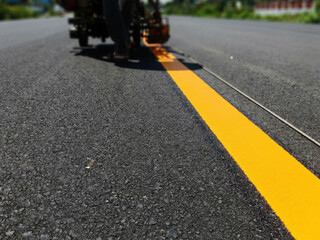
The drying principle of thermoplastic road paint is best understood as a cycle of heating, application, and cooling. This sequence is carefully managed with specialized equipment to guarantee quality lines that are both durable and reflective.
In the preheater or kettle, solid thermoplastic granules or powder are raised to 180–210 °C. At this point, resins, pigments, and additives form a uniform molten mixture, ready for line application. Strict temperature control is essential, since overheating can degrade resins and underheating can cause poor flow.
The molten material is transferred into a road marking machine, which dispenses the paint in controlled widths and thicknesses. At the same time, reflective glass beads are dropped onto the surface, embedding themselves into the hot paint layer to ensure nighttime visibility.
Once on the pavement, the hot paint quickly loses heat to the cooler road substrate. This rapid heat transfer drives solidification, transforming the fluid material into a strong, wear-resistant coating. The process is not about chemical reaction, but about thermal exchange—a fact that explains why external conditions can either accelerate or delay drying.
Even though thermoplastic road paint is engineered for fast solidification, site conditions sometimes extend drying time. Contractors must recognize these scenarios to adjust schedules and techniques accordingly.
In high ambient temperatures, especially above 35 °C, the heat difference between the molten paint and the road is smaller. This reduces the rate of heat loss, delaying solidification. Conversely, in cooler environments, the paint hardens more rapidly because the pavement absorbs heat faster.
Midday applications, from late morning to mid-afternoon, often face delayed drying due to heated pavement surfaces. The thermal load accumulated in the asphalt or concrete slows down cooling, while early morning or evening applications benefit from cooler roadbeds.
High humidity or damp conditions can complicate the process. While moisture does not chemically interfere with thermoplastic, it affects pavement temperature and may create localized condensation, leading to uneven cooling or adhesion issues. Contractors should monitor both weather forecasts and on-site humidity levels before work.
Not all pavements respond to hot thermoplastic in the same way. Surface material, texture, and thermal properties each play a role in how fast the markings harden.
Asphalt, being dark and absorptive, tends to retain more heat, which can slow down the cooling of applied paint. Concrete, in contrast, has higher thermal conductivity and reflects heat, which often results in faster drying. Contractors should anticipate longer curing times on freshly laid or sun-heated asphalt.
On very hot roads, the pavement acts as a heat reservoir, releasing warmth back into the coating instead of absorbing it. This reverses the usual cooling effect, extending drying times. Identifying and avoiding such conditions is key to keeping traffic disruption minimal.
Properly cleaned and, if needed, preheated surfaces ensure better adhesion and more consistent cooling. Dust, moisture, or oil layers interfere with heat transfer and bonding. A well-prepared surface is therefore a practical solution to speed up both drying and long-term performance.
Thermoplastic paint is not uniform across all manufacturers. Differences in resin type, fillers, and bead content can make a significant difference in drying speed and performance.
Premium resins with controlled softening points provide predictable and quick hardening. Lower-grade resins may stay tacky for longer, increasing the risk of dust pick-up or traffic smudging. Buyers should always request technical data sheets to verify resin specifications.
Excessive use of anti-settling agents or low-melting-point fillers can slow the cooling process. While these ingredients add processing stability, they must be balanced to avoid compromising drying efficiency. Skilled formulation is the difference between a professional-grade paint and a problematic one.
Glass beads, while crucial for reflectivity, affect viscosity when present in large amounts. Overloading can change flow dynamics, making the paint layer thicker and slower to cool. The right balance ensures both brightness at night and efficient drying on site.
Contractors and procurement officers are not powerless in the face of slow-drying lines. Several practical measures can help maintain project timelines while ensuring quality.
Scheduling applications in early morning or evening avoids peak pavement temperatures. This simple planning step can reduce drying times by minutes, which adds up significantly in large-scale projects where traffic reopening is critical.
Suppliers offer fast-dry variants designed for hot and humid climates. Requesting tailored formulations ensures that the paint aligns with project geography. Buyers should collaborate with suppliers who can adjust resins, fillers, and bead ratios for regional conditions.
Preheaters, temperature-controlled kettles, and road surface warmers provide precise control over the thermal cycle. Contractors who invest in quality equipment achieve not only faster drying but also more consistent film thickness and adhesion, reducing rework costs.
Standards compliance (AASHTO M249, BS 3262, TCVN 8791:2011) signals that the paint has undergone rigorous testing for drying speed and durability. Buyers should seek suppliers that can provide certificates, performance test data, and after-sales technical support to minimize risks on site.
Thermoplastic road paint dries not by evaporation but by cooling and hardening. This makes it faster, cleaner, and more sustainable than conventional paints, but also sensitive to conditions such as heat, humidity, and pavement type. Slowed drying is not a flaw but a predictable outcome of physics—one that can be managed with the right strategies.
For contractors, the lesson is clear: time your work wisely, prepare surfaces diligently, and equip your teams properly. For procurement officers, the path is to choose reputable suppliers offering high-quality, customized formulations that meet international standards. When both sides act strategically, projects benefit from markings that are not only quick to dry but also long-lasting and safe.
By integrating technical know-how with practical planning, buyers and contractors can ensure that thermoplastic road paint continues to deliver on its promise: durable, reflective lines that guide traffic safely—day and night, in every climate.


