When selecting a road marking machine, buyers often face the choice between hand-push models and self-propelled models. Each type has unique operating methods, advantages, and limitations, making them suitable for different project scales and budgets. Below, we break down the key differences and provide guidance on how to choose the right option for your needs.
Hand-push machines are manually operated and are widely used for small and medium-scale projects. They are cost-effective, portable, and easy to maintain, making them a popular choice among contractors starting out.
The operator pushes the machine forward manually while controlling the paint tank, screed box, and glass bead dispenser. The process requires physical effort and steady handling to ensure straight, clean lines.
These machines are lightweight, compact, and easy to transport. They have lower upfront costs and are suitable for narrow or confined spaces such as parking lots, schools, and community roads. Maintenance is simple due to fewer mechanical components.
Hand-push machines rely on manpower, which limits marking speed and consistency over long distances. They are less suitable for highways or projects requiring high output and efficiency. Operator fatigue can also affect line quality.
Ideal for small projects, tight spaces, and jobs where budget is limited. Commonly used in parking areas, residential roads, campus projects, and local maintenance tasks.
Self-propelled machines are powered units designed for larger and more demanding projects. They reduce manual effort and deliver higher productivity, making them suitable for professional contractors.
The machine is engine-driven and moves forward automatically. Operators focus on controlling line width, thickness, and glass bead distribution rather than pushing, which ensures consistent marking results.
High efficiency and reduced labor intensity are the main benefits. These machines can maintain steady speeds, produce uniform lines, and cover larger areas quickly. They are durable and often come with advanced features like adjustable speeds and precision controls.
Self-propelled machines are more expensive to purchase and maintain. They require trained operators and are less suitable for confined spaces due to their larger size and weight. Transportation can also be more complex.
Perfect for highways, airports, municipal roads, and large-scale infrastructure projects where efficiency and consistency are critical.
Hand-push machines are more labor-intensive, slower, and best suited for short-distance marking, while self-propelled machines excel in efficiency, speed, and quality for large-scale projects. The trade-off comes down to balancing budget, manpower, and project requirements.
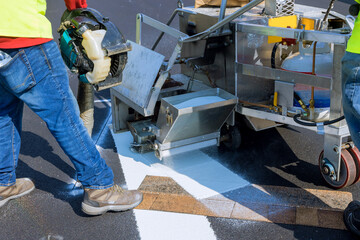
Choosing the right machine depends on several critical factors. Below are the main considerations buyers should evaluate before making a decision.
For small or occasional projects, hand-push machines are more economical. For highways, airports, and city contracts, self-propelled models are the practical choice due to their efficiency.
If the team is small or lacks experienced operators, a hand-push machine may be easier to manage. Larger teams with skilled workers can maximize the benefits of self-propelled equipment.
Hand-push machines have lower purchase costs and operating expenses, making them suitable for contractors with limited budgets. Self-propelled machines involve higher investment but reduce labor costs and increase long-term productivity.
For narrow spaces, parking lots, or community roads, hand-push machines are more flexible. For wide roads, highways, and large-scale sites, self-propelled machines offer better stability and efficiency.
Both hand-push and self-propelled road marking machines play important roles in the industry. Hand-push models are best for small-scale, low-budget, and confined-area projects, while self-propelled machines are suited for large-scale, professional operations requiring speed and consistency. Buyers should assess project size, manpower, budget, and site conditions to make the most cost-effective and practical choice.


