Learn the complete process of thermoplastic road marking paint construction, including surface preparation, primer use, heating, line application, glass bead spreading, cooling, inspection, and maintenance. Practical tips and quality standards ensure durable and reflective road markings.
Introduction
Thermoplastic road marking paint is widely applied on highways, municipal roads, airports, and parking lots thanks to its durability and high retroreflectivity. Standardized construction is critical for ensuring long-lasting adhesion, clean line shape, and consistent brightness of road markings.
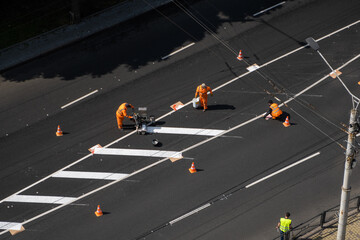
I. Prerequisites
Environmental Requirements
- Pavement temperature must be ≥10°C to avoid adhesion failure.
- Relative humidity should be below 85%.
- Do not apply during rain, snow, or strong winds.
Traffic Control
- Traffic closure must be enforced before construction and maintained until markings are fully cooled and cured.
Materials
- Thermoplastic road marking paint (solid granular form)
- Reflective glass beads (particle size: 150–850 μm)
- Primer (adhesion enhancer)
Equipment
II. Main Construction Steps
1. Road Surface Cleaning and Preparation
- Thoroughly clean dust, oil stains, and debris; moisture content must be <3%.
- Mark positions with chalk lines or reference points; remove old markings if necessary.
- Apply primer 0.2–0.3 kg/㎡ evenly, slightly wider than the intended line. Drying time: 5–10 minutes (touch-dry).
Note: Primer is a hazardous product. Confirm legal transportation and storage requirements with the supplier.
2. Material Melting and Heating
- Heat thermoplastic paint in a preheater kettle to 180–220°C (adjust based on resin type).
- Stir continuously until melted completely (no granules, uniform fluidity).
- Maturation time: 3–5 minutes before transfer to marking machine hopper.
- Overheating (>230°C): risk of resin decomposition and durability loss.
- Underheating (<170°C): poor flow, rough line surface.
Note: Petroleum resin–based paint should not be held in the kettle more than 6 hours; rosin resin–based paint not more than 4 hours.
3. Line Application
- Operate the hand-push marking machine steadily at recommended temperature (180–200°C for spraying, 200–220°C for scraping).
- Film thickness: 1.5–2.5 mm (≥2.0 mm recommended for highways).
- Ensure straight lines, neat edges, no overflow or ragged edges.
Application Methods: Scraping method is used for arrows, texts, and symbols; spraying method for continuous lines.
4. Glass Bead Application
- Beads must be applied while paint is molten (at 100–120°C surface temperature).
- Standard dosage: 300–500 g/㎡; for high retroreflectivity, 600–800 g/㎡ with 10% premix beads inside paint.
- Embedding depth: about 50–60% of bead diameter.
Methods:
- Intermix: beads mixed inside paint for long-term durability.
- Drop-on: beads applied on paint surface for strong initial brightness.
Optimization Tip: Use dual-layer spreading: larger beads first, smaller beads after, for layered reflectivity.
Note: Many contractors now use thermoplastic with intermix beads already included; the final approach should match project requirements and material type.
5. Cooling and Curing
- Natural cooling time: 3–5 minutes at 25°C ambient temperature.
- Maintain traffic closure until markings are fully hardened (10–15 minutes).
- Final acceptance criteria: no bubbles or cracks, clean edges, retroreflectivity ≥250 mcd·m⁻²·lx⁻¹.
III. Quality Inspection and Maintenance
- Use thickness gauges and retroreflectometers to confirm line quality.
- Adhesion can be tested using tape pull method.
- Regularly clean markings to avoid dust covering glass beads.
- For regions with strong UV, consider UV-resistant modified thermoplastic.
For troubleshooting during or after construction, see Common Construction Issues and Solutions.

IV. Conclusion
A well-standardized process ensures durable, highly reflective, and aesthetically clean road markings. Before construction, confirm primer handling and transport requirements, glass bead method, environmental conditions, and heating parameters. By carefully controlling each detail, contractors can prevent common defects such as bubbling, peeling, or poor reflectivity, ensuring long service life of BOLE road marking projects.


