| Item | AASHTO M249 (US) | BS 3262 Parts 1–3 (UK) | JT/T 280-2022 (+ GB/T 16311) (CN) |
|---|---|---|---|
| Composition (mass %) | |||
| Binder (C5 resin) | ≥18% | 18–22% | ≥15–18% |
| Premixed glass beads | 30–40% | 18–25% | ≥20–30% (RI ≥1.5) |
| Titanium dioxide (white) | ≥10% | 8–12% | ≥5–10% |
| Environmental | Lead-chromate-free; solvent-free/low VOC | Lead-chromate-free; consistent quality | Low VOC; lead-chromate-free |
| Key Physical Properties | |||
| Softening point (°C, R&B) | ~80–90 | ~80–90 | ~100–110 |
| Flow time / Liquidity (s @ ~200 °C) | typ. 90–110 | typ. 90–110 | typ. 90–110 |
| Density (g/cm³) | — | — | ~1.8–2.1 |
| Wear resistance (mg loss) | ≤~50 (typ.) | ≤~48 (typ.) | ≤42 |
| Drying / No-pick-up (min) | 2–5 | 3–5 (no-pick-up ≤2) | ≤3 |
| Heat resistance | ~170 °C × 4 h, no significant change (typ.) | — | Stable at 200–220 °C for 4 h |
| Visibility & Safety | |||
| Initial retroreflectivity RL (mcd·m⁻²·lx⁻¹) | Project-/bead-dependent | Primarily luminance/chromaticity-based | White/Yellow ≥150 (initial) |
| Luminance / Brightness (%) | — | White ≥70%, Yellow ≥45% | White ≥75%, Yellow ≥50% |
| Skid resistance (BPN) | — | Per ASTM E303 (commonly ≥45–55) | Per GB/T 16311 |
| Application Parameters | |||
| Application temperature (°C) | 180–220 | 180–220 | 180–220 |
| Line thickness (mm) | 1.5–3.0 | 1.9 ± 0.4 | 1.5–3.0 |
| Drop-on beads (g/m²) | 250–400 | Manufacturer’s recommendation (often 250–400) | 350–450 (RI ≥1.5) |
| Primer on concrete | Recommended | Recommended | Recommended (~0.2–0.3 kg/m²) |
| Durability & Environment | |||
| Water/alkali resistance (24 h) | No discoloration, wrinkling, blistering, cracking | No discoloration, wrinkling, blistering, cracking | No discoloration, wrinkling, blistering, cracking |
| VOC & heavy metals | Solvent-free/low VOC; lead-chromate-free | Low VOC; lead-chromate-free | Low VOC; lead-chromate-free |
| Compliance & Packing | |||
| Standards | M249 (solid thermoplastic striping material) | BS 3262 Parts 1–3 (hot-applied materials) | JT/T 280-2022 (with GB/T 16311 test methods) |
| Packing & shelf life | 25 kg/bag; store cool & dry; shelf life 24 months (unopened) | ||
Note: Values above are “verifiable fields” for product page comparison. Final supply follows project specifications/tender docs and sample testing; test methods per each standard or equivalent.
| Parameter | Typical Value |
|---|---|
| Model | BPW75-X-0-X |
| Appearance | Powder (solid thermoplastic powder) |
| Application Method | Hot melt |
| Whiteness | 75 |
| Heating Temperature (°C) | 180–210 |
| Softening Point (°C) | 108 |
| Drying Time (min) | 4 |
| Compressive Strength (MPa, 23 °C ±1) | 20.01 |
| Compressive Strength (MPa, 60 °C ±1) | 1.24 |
| Density (g/cm³) | 1.88 |
| Brightness Factor | 0.79 |
| Wear Resistance (mg loss) | ≤59 |
| Water Resistance | No discoloration, wrinkling, blistering, cracking, etc. after 24 h water soak |
| Alkali Resistance | No discoloration, wrinkling, blistering, cracking, etc. after 24 h saturated calcium hydroxide soak |
| Liquidity (s) | 89 |
| Heat Resistance | 92.8 (per internal method) |
| Melting Time | 20 minutes per 400 kg cylinder |
| Retroreflectivity — Normal drop-on beads (RL) | 200–250 mcd·m⁻²·lx⁻¹ |
| Retroreflectivity — High-brightness beads (RL) | 250–300 mcd·m⁻²·lx⁻¹ |
| Adhesion | 0.6 MPa |
| Precipitation | NO |
| Shelf Life | 1 year (unopened, stored properly) |
| Storage Conditions | Store sealed in a cool, dry, well-ventilated place; avoid moisture and direct sunlight |
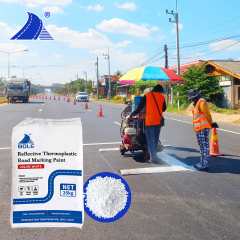
Thermoplastic road marking paint — also called thermoplastic road marking material, hot-melt road marking paint— is a solid, solvent-free powder blend that forms a durable traffic line when heated and applied to pavement.
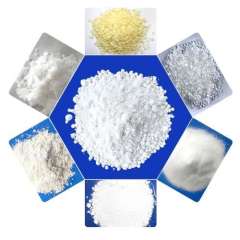
The material typically contains a hydrocarbon resin binder (C5), pigments (e.g., TiO₂ for white), mineral fillers (e.g., CaCO₃), and performance additives. It may include premixed glass beads for internal reflectivity, while additional drop-on beads are broadcast during application to create a high-retroreflective surface. The compound is melted to about 180–210 °C and laid down by screed, extrusion, or specialized spray systems at a typical film thickness of 1.5–3.0 mm. As it cools, it solidifies within minutes into a dense, wear-resistant, and bead-anchoring layer.
Long-life center/edge lines, lane arrows, and rumble/profiled markings under heavy traffic. Typical film thickness 2.0–3.0 mm; drop-on glass beads 250–400 g/m² (RI ≥1.5), with high-brightness beads for elevated RL at night and in wet conditions.
Crosswalks, stop lines, turn arrows, bus/bike lanes, and symbols where rapid reopening is critical. Fast no-pick-up time (~2–4 min) minimizes congestion; use primer on concrete and consider anti-skid aggregates where higher BPN is required.
High-visibility guidance on landside roads, aprons, and cargo areas exposed to UV, oils, fuel drips, salt spray, and intensive service traffic. Specify bead systems for sustained retroreflectivity and confirm local airfield/port specifications before use.
Stall lines, ADA/access markings, speed humps, zebra crossings, and directional symbols. Cost-effective thickness 1.5–2.0 mm with drop-on beads for nighttime visibility; primer recommended on concrete substrates.
Heats and mixes the thermoplastic powder to 180–210 °C before transfer to the marking machine. Choose single- or double-cylinder designs with mechanical/hydraulic stirring and LPG burners.
Applies molten material onto pavement at controlled thickness and width. Select the mechanism based on project scale and line type.
Broadcasts drop-on beads immediately after application to create retroreflectivity.
Ensures bonding—especially on concrete—and clean, dry surfaces.
Removes failed or obsolete markings prior to re-application.
| Feature | Thermoplastic Paint | Cold Paint |
|---|---|---|
| Drying Time | 3–5 minutes (traffic-ready) | 30–60 minutes (weather dependent) |
| Application Method | Heated to 180–210°C, applied hot with machine | Spray or roller application, no heating |
| Durability | 3–5 years (high resistance to wear) | 6–12 months (moderate durability) |
| Reflectivity | High (glass beads embedded while hot) | Medium (beads adhere to wet surface) |
| Material Cost | Higher upfront investment | Lower initial cost |
| Recommended For | Highways, urban roads, airports, logistics parks | Parking lots, short-term zones, low-traffic areas |
Thick films (1.5–3.0 mm) and high-binder systems deliver durable lines under heavy traffic, reducing repaint frequency and life-cycle cost.
Drop-on glass beads are mechanically anchored into the thermoplastic matrix for sustained retroreflectivity (typical RL ranges: 200–300 with normal beads; 300–400 with high-brightness beads).
Hot-applied material sets within minutes (no-pick-up ~2–4 min), minimizing lane closure time and improving work-zone safety.
Solvent-free, lead-chromate-free options; engineered to comply with AASHTO M249, BS 3262, and JT/T 280 (+ GB/T 16311 test methods).
4,200 m² plant with 50,000 t/year capacity ensures stable supply and short delivery times for both domestic and export orders.
Formula tuning for climate and traffic (bead content, TiO₂ level, resin/filler balance), color matching, and private-label packaging (25 kg bags, palletized).
In-house QC aligned with AASHTO M249 / BS 3262 / JT/T 280 & GB/T 16311; 14 production patents, batch traceability, and documentation support.
24/7 technical support, equipment pairing guidance, and export experience across Spanish-speaking and Asian markets for smoother projects end-to-end.
At a standard film thickness of 2 mm, BOLE thermoplastic typically covers 180–200 m² per ton. Use these quick formulas:
Required paint (tons) = Marked area (m²) ÷ 180–200Line length (m) per ton = 180–200 ÷ Line width (m)Notes: Actual consumption varies with surface texture, primer use (on concrete), bead rate, application method (screed/extrusion/spray), and waste/overlap.
| Line Width | Length per Ton (Conservative 180 m²) | Length per Ton (Ideal 200 m²) |
|---|---|---|
| 100 mm (0.10 m) | ≈ 1,800 m | ≈ 2,000 m |
| 150 mm (0.15 m) | ≈ 1,200 m | ≈ 1,333 m |
| 200 mm (0.20 m) | ≈ 900 m | ≈ 1,000 m |
| 300 mm (0.30 m) | ≈ 600 m | ≈ 667 m |
| 400 mm (0.40 m) | ≈ 450 m | ≈ 500 m |
Pricing depends on formula (bead/TiO₂ level, pigments), color (white/yellow), specification (AASHTO M249 / BS 3262 / JT/T 280), order quantity, and Incoterms (FOB/CIF/DDP). As a general reference for standard white/yellow thermoplastic, typical FOB China ranges are USD 300–700 per ton. High-brightness/bead-rich or specialty formulations may be higher. Drop-on glass beads and primer are quoted separately.
For an accurate quote, share your target standard, bead system (normal or high-brightness), line thickness, total quantities, destination port, and whether you need machinery (preheaters, applicators) and logistics support.
Remove dust, oil, loose particles, and moisture. Use an air blower; grind laitance on concrete. On concrete, apply primer (~0.2–0.3 kg/m²) and allow it to flash off before marking.
Heat the material to about 180–210 °C in the preheater. Keep it well mixed and avoid overheating. Apply at stable temperature to achieve smooth flow and bonding.
Typical film thickness is 1.5–3.0 mm. Highways often use 2.0–3.0 mm for longevity; parking and municipal work can use 1.5–2.0 mm depending on specification.
Thermoplastic sets within minutes. Typical no-pick-up is about 2–4 minutes, depending on pavement temperature, wind, and humidity.
Use 250–450 g/m² (RI ≥1.5) immediately after laydown. Calibrate the bead dispenser and confirm uniform coverage; use high-brightness beads where higher RL is required.
Primer is recommended on concrete, polished surfaces, or where existing markings are heavily worn. It improves adhesion and reduces early edge lifting.
Check melt temperature (raise gradually within spec), mixing, and moisture contamination. Verify the kettle thermometer, and avoid prolonged high-temp holding that can degrade the binder.
Late bead drop, low drop rate, or surface contamination can reduce anchoring. Ensure beads are broadcast immediately and adequately; confirm bead quality (sphericity and RI).
Avoid rain/wet surfaces. Pavement and ambient temp should generally be above 5 °C and rising. Pre-warm the surface if needed; stop if dew or condensation appears.
At 2 mm thickness, typical coverage is 180–200 m² per ton. Texture, waste, bead rate, and rework can change actual consumption.
Formulations are engineered to align with AASHTO M249 (US), BS 3262 (UK), and JT/T 280 with GB/T 16311 test methods (CN). Provide your target spec in the RFQ.
Project standard, color (white/yellow), target RL (normal or high-brightness beads), line thickness, estimated tonnage, Incoterms (FOB/CIF/DDP), destination port, and whether you need machines or primer/beads.
FOB China for standard thermoplastic is typically USD 300–700/ton depending on formulation, color, and volume. Drop-on beads and primer are quoted separately.
Lead time depends on order size and customization. Standard SKUs are usually ready within short cycles; export scheduling and vessel space affect total transit time.
Standard 25 kg bags, palletized for export. Private-label/OEM packaging can be arranged.
COA/test report (batch), MSDS, packing list, commercial invoice, and related compliance documents. Certificates can reference your target standard on request.
Yes—OEM/ODM for climate, traffic level, bead/TiO₂ content, color matching, and special performance (e.g., high RL, higher skid resistance).
1 year unopened in a cool, dry, ventilated place; avoid moisture and direct sun. Rotate stock FIFO.
Yes—preheaters, marking machines, bead dispensers, line removers, primer, and drop-on glass beads. We can package a one-stop supply.
24/7 technical support for application guidance, troubleshooting, and QC advice. We can review your method statements and bead settings before deployment.