Reflective glass beads and road marking paint are critical components in modern road safety and infrastructure. From enhancing nighttime visibility to improving durability, these materials ensure clear and long-lasting road markings. Explore their types, applications, and industry standards to understand how they contribute to safer and smarter roadways.
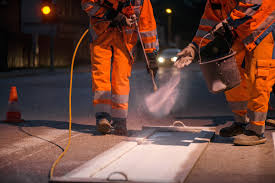
1. Classification by Application and Function
Types: Pre-mixed (embedded) and surface-sprinkled. Pre-mixed beads ensure long-term reflectivity, while surface-sprinkled beads provide immediate reflectivity during application.
Functions:
- Enhanced Retroreflection: Improves visibility of road markings at night or in low-light conditions, ensuring road safety.
- Durability: Bonds strongly with road marking paint, resisting wear and pollution for extended service life.
- Rainy Night Visibility: Specialty coated beads maintain reflectivity in wet conditions, enhancing safety in harsh weather.
Industrial Grinding and Blasting Glass Beads
Types: Silicate, aluminate, etc.; microbeads (<1mm) and standard beads.
Functions:
- Surface Treatment: Polishes metals, plastics, and ceramics, removing oxidation or burrs for a smooth finish.
- Precision Processing: Used as grinding media in microelectronics and medical devices to improve product accuracy.
Decorative and Craft Glass Beads
Types: Single-color, multi-color; transparent, frosted; round or shaped (heart, star, etc.).
Functions:
- Jewelry and Fashion: Enhances aesthetics and artistic value in bracelets, necklaces, and more.
- Architectural Decoration: Adds gloss and texture to walls, floors, and decorative materials.
Filler and Functional Glass Beads
Types: Hollow beads (lightweight insulation) and solid beads (reinforcement).
Functions:
- Lightweighting: Reduces material density in plastics and rubber while improving strength.
- Insulation and Filtration: Used as insulation in construction or as filter media in water treatment.
2. Classification by Physical Properties
Refractive Index
- Low (1.5-1.7): Cost-effective for standard road markings.
- High (1.9-2.4): Ideal for reflective films and rainy night markings with longer reflectivity.
Particle Size Distribution
- Road Markings: No. 1 (surface-sprinkled), No. 2 (pre-mixed), No. 3 (solvent-based paint), No. 4 (rainy night).
- Industrial Blasting: Ranges from 20 to 400 mesh, selected based on surface roughness.
Material and Color
- Colorless and Transparent: Versatile for reflective and grinding applications.
- Colored/Coated: Used for decoration or special functions (e.g., moisture resistance).
3. Industry Standards and Quality Requirements
National Standards
- China (GB/T 24722-2020): Specifies particle size, roundness (≥80%), and refractive index for road marking beads.
- USA (AASHTO M247/M247-21):
- Type I: For standard climates, uniform particle size, and roundness ≥80%.
- Type II: For high humidity or rainy nights, with coated beads for enhanced reflectivity.
- Type III: For extreme climates (e.g., snow), with stronger weather resistance and refractive index ≥1.9.
Key Parameters
- Roundness: Affects reflectivity uniformity; defective beads must be ≤20%.
- Cleanliness: Impurities reduce reflectivity and must be strictly controlled.
- Corrosion Resistance: High-refractive-index beads offer better durability.
4. Application Scenarios
- Traffic Safety: Highway and airport runway markings, traffic sign reflective films.
- Industrial Manufacturing: Automotive part polishing, precision casting cleaning.
- Construction and Home Decor: Decorative materials, lamp reflectors.
- Medical and Electronics: Instrument encapsulation, optical coatings.
Take Action Today!
For detailed product information or technical support, contact us at:
Reflective Glass Beads and Road Marking Paint are essential for safer, smarter, and more durable roadways. Contact us now to elevate your projects!


