Table of Contents
Sustainability has become a defining priority in road infrastructure projects worldwide. Beyond performance and durability, contractors and buyers now evaluate materials based on their environmental impact. Among all road marking solutions, thermoplastic road marking paint stands out as the most widely used, balancing safety, visibility, and eco-friendliness. This article identifies the key eco-friendly features of thermoplastic paints and provides procurement tips for buyers.
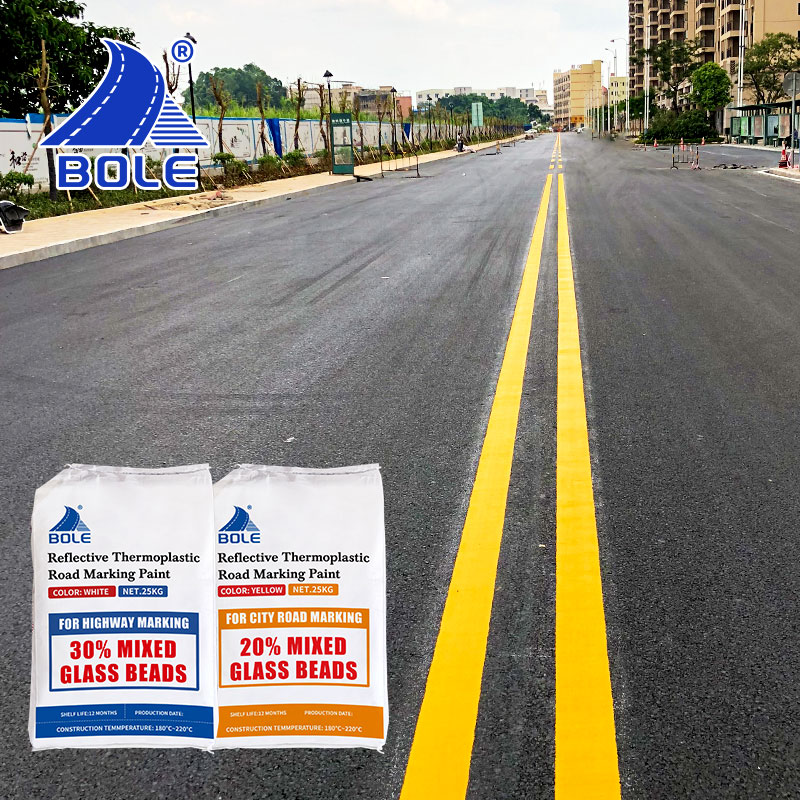
Volatile Organic Compounds (VOCs) are a major source of air pollution in traditional solvent-based paints. Thermoplastic paints, however, contain no organic solvents and release virtually zero VOCs during application. This makes them one of the cleanest materials available for road marking.
Conventional solvent-based road paints often release high VOC levels, which contribute to smog formation and pose health risks. Agencies like the U.S. EPA and EU REACH have set strict limits, making these products increasingly restricted. In contrast, thermoplastics comply naturally without added solvent controls.
Waterborne and two-component (2K) road paints are alternative low-VOC solutions, but they typically offer shorter durability than thermoplastics. While suitable for temporary or low-traffic projects, they cannot match the longevity of hot-melt systems.
Procurement specifications often reference standards such as EN 1871 (Europe), EPA 40 CFR (USA), and CARB VOC limits (California). Thermoplastic paints meet or exceed these requirements by default.
Color stability and brightness are essential for road markings, but traditional pigments have sometimes posed environmental risks. Lead chromate (PbCrO₄) in yellow paints is a prime example, now heavily restricted worldwide.
Lead and hexavalent chromium are toxic to humans and ecosystems. Under EU REACH regulations, their use in coatings has been banned. Continued reliance on these pigments poses legal and environmental liabilities for contractors.
Modern thermoplastic paints use safer pigments such as titanium dioxide for whites and organic yellow pigments. These provide high brightness and durability without toxic effects, aligning with global sustainability goals.
Glass beads, critical for retroreflectivity, must also meet eco-standards. EN 1423 and EN 1424 require that beads be lead-free and environmentally safe, ensuring that nighttime visibility does not come at a hidden environmental cost.

Independent certifications provide confidence that materials are safe for people and the planet. Buyers should always check for recognized eco-labels and management standards.
ISO 14001 ensures that manufacturers implement environmental management systems. Suppliers holding this certification demonstrate long-term commitment to reducing environmental impact.
Products with EU Ecolabel, Blue Angel (Germany), or Green Seal (USA) offer proven environmental advantages. These labels evaluate life cycle performance, not just compliance with basic regulations.
In Asia, labels like China Environmental Label are gaining traction. Buyers working on public projects should prioritize suppliers with both international and local recognition to satisfy diverse project requirements.
Thermoplastic paints require high-temperature application, meaning worker safety and environmental control are essential. Proper practices protect both workers and surrounding communities.
Operators should wear PPE including heat-resistant gloves, face shields, and flame-retardant clothing. These measures protect from burns and hot material exposure during application.
Marking projects require barricades, cones, and warning lights. Ventilation is crucial when working in tunnels to prevent heat buildup and smoke accumulation.
Unlike solvent-based paints, thermoplastics do not release toxic fumes, reducing the need for heavy respirators. This improves working conditions and lowers health risks.
Sustainable road marking goes beyond application—it includes proper waste handling. Leftover materials, bead residues, and removed markings must be managed responsibly.
Unused molten thermoplastic should be cooled and stored for future use rather than discarded. This reduces both costs and waste volume.
When old lines are milled off, chips and dust must be collected to prevent soil and water contamination. Specialized vacuum systems are recommended for large projects.
Wastewater from cleaning equipment must be treated or filtered before disposal. Licensed disposal channels ensure compliance with environmental regulations.
Thermoplastic paints align naturally with eco-friendly road construction goals. Their material properties reduce emissions, waste, and lifecycle costs.
Thermoplastic systems are inherently free of harmful solvents, making them the lowest-VOC choice among road paints.
With a service life of 2–3 years, thermoplastic markings reduce repaint frequency. This minimizes raw material consumption, energy use, and CO₂ emissions over time.
In some systems, scrap thermoplastic can be reprocessed, offering further environmental benefits compared to paints that become permanent waste.
BOLE provides sustainable marking solutions that meet global performance and environmental standards. Our products are designed to combine visibility, safety, and eco-friendliness.
BOLE’s formulations exclude lead and chromium, using titanium dioxide and organic pigments for safety. Glass beads are certified lead-free under EN 1423/1424.
Our thermoplastic paints comply with BS 3262, AASHTO M249, and EN 1871. Our factory holds ISO 9001 and ISO 14001 certifications, ensuring quality and environmental responsibility.
We offer customized eco-friendly formulations tailored to project specifications. Buyers receive MSDS, COA, and certification reports for smooth procurement. Learn more about product lifespan here: Thermoplastic Road Marking Paint Service Life.
Eco-friendly thermoplastic paints combine solvent-free chemistry, lead-free pigments, and internationally recognized certifications. For contractors and buyers, the key evaluation factors are VOC content, pigment safety, environmental certifications, and supplier credibility. By choosing sustainable thermoplastic solutions, road projects can enhance traffic safety while reducing environmental impact. For more product details, visit BOLE Official Website.


